Introduction: The Fear That Keeps Contractors Underpaid
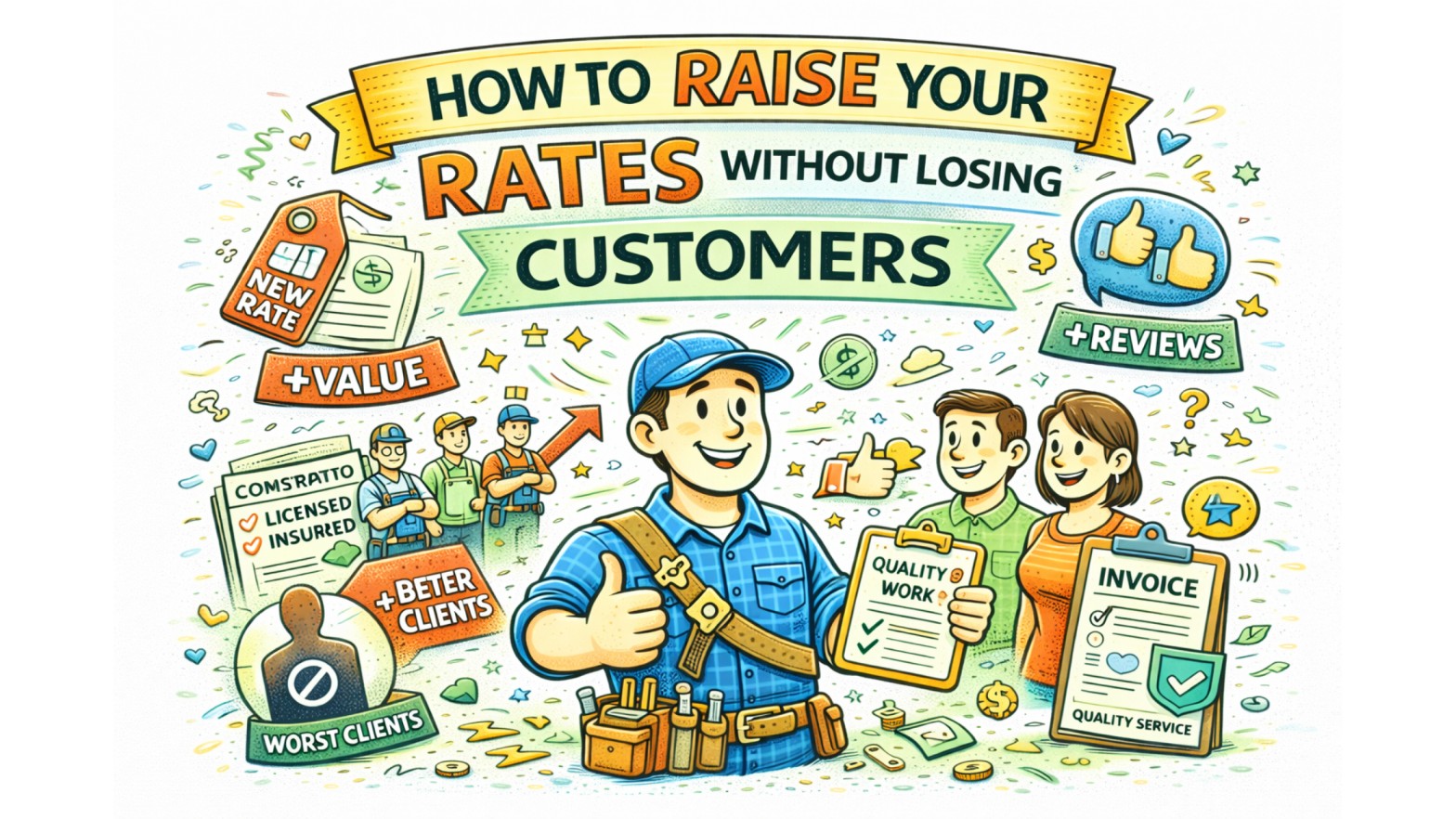
Most contractors know they should raise their rates.
But they don't.
Why?
Because they're afraid of losing customers.
They think:
- "What if they go with someone cheaper?"
- "What if my schedule dries up?"
- "What if reviews drop?"
So they stay underpriced.
They stay overworked.
They stay stressed.
Here's the truth:
The problem is not raising rates.
The problem is raising them incorrectly.
Let's fix that.
1. Understand This First: The Cheapest Contractor Is Always Replaceable
If customers choose you only because you're cheaper,
they will leave you for someone cheaper.
Price-based loyalty is fragile.
Value-based loyalty is durable.
When you raise rates strategically, you attract:
- Better customers
- More serious customers
- More respectful customers
And you reduce price shoppers.
2. Raise Rates Gradually — Not Dramatically
One of the biggest mistakes contractors make is jumping too far, too fast.
Instead of:
$90 → $150 overnight
Try:
- $90 → $105
- Then $105 → $120
- Then $120 → $135
Small increases feel reasonable.
And most customers won't even question moderate adjustments — especially if they trust you.
3. Improve Your Communication Before You Raise Prices
You don't raise rates.
You increase perceived value.
Start saying things like:
Instead of:
"Here's your quote."
Say:
"Here's what this includes…"
Explain:
- Safety considerations
- Code compliance
- Warranty coverage
- Quality materials
- Clean workmanship
- Follow-up support
Customers pay more when they understand what they're paying for.
4. Raise Rates With New Customers First
The safest way to test higher pricing is:
Charge new customers your updated rate.
Keep existing loyal customers stable for a short period if needed.
This lets you:
- Measure demand response
- Build confidence
- Transition gradually
Often, contractors discover:
New customers accept higher rates more easily than expected.
5. Stop Apologizing for Your Pricing
Many contractors undermine themselves with language like:
- "I know it's a little high…"
- "I can try to discount…"
- "I might be more expensive…"
Confidence is part of value perception.
Instead say:
"This reflects the quality, safety, and warranty we provide."
If you don't respect your rate, customers won't either.
6. Improve Your Positioning Before You Increase Prices
Raising rates works best when paired with:
- Strong reviews
- Clear branding
- Professional communication
- Clean invoicing
- Organized scheduling
- Clear scope documentation
Customers don't mind paying more.
They mind paying more to someone who looks disorganized.
Professional presentation supports premium pricing.
7. Eliminate Your Worst Customers First
Some customers:
- Always negotiate
- Always delay payment
- Always complain
- Always compare bids
Losing them is not a loss.
Raising your rates filters them out naturally.
That frees time for:
- Higher-quality clients
- Repeat customers
- Larger projects
Sometimes raising rates reduces stress immediately.
8. Improve Your Job Selection
If you fill your schedule with:
- Small, low-margin jobs
- Long travel jobs
- Emergency chaos
You feel pressured to stay cheap.
Instead:
- Prioritize higher-value jobs
- Group jobs geographically
- Offer bundled services
- Suggest upgrades
Better job mix supports higher rates.
9. Use Data, Not Emotion
Before raising rates, ask:
- What is my effective hourly rate?
- What are my real expenses?
- What is my target income?
- How much non-billable time do I absorb?
If the math demands higher pricing,
raising rates isn't greed — it's survival.
This is business discipline.
10. Platforms and Pricing Pressure
If you rely heavily on platforms that:
- Promote bidding wars
- Reward lowest price
- Charge high commissions
- Encourage fast-response competition
Raising rates becomes harder.
You may need to diversify your work sources.
Marketplaces that allow:
- Direct communication
- Margin protection
- Job selection control
Support higher pricing more naturally.
The goal isn't avoiding platforms —
It's choosing platforms aligned with long-term profitability.
11. The Psychology of Pricing
Customers assume:
Higher price = higher quality.
If you are:
- Licensed
- Insured
- Experienced
- Professional
Then your pricing should reflect that.
Underpricing sends the wrong signal.
In many cases, slightly higher pricing increases trust — not reduces it.
12. The Long-Term Result of Raising Rates Properly
When contractors raise rates strategically:
- They work fewer jobs
- They earn more per job
- They reduce stress
- They improve client quality
- They regain control
Lower volume.
Higher margin.
Better lifestyle.
That's the goal.
Conclusion: You Don't Need More Work — You Need Better Work
Raising your rates is not about greed.
It's about:
- Sustainability
- Confidence
- Professional respect
- Business longevity
If you feel constantly busy but financially strained,
your pricing likely needs adjustment.
The contractors who grow in 2026 aren't the cheapest.
They're the clearest about their value.
Frequently asked questions
How do I raise my rates without losing customers?
Raise them gradually and explain what the price covers. The problem is not raising rates, it is raising them incorrectly. Rather than jumping from $90 to $150, step up through $105, $120, and $135 so the change is absorbable. Pair each increase with a clear account of what the client is actually buying.
How much should I increase my rates at one time?
Move in steps small enough that clients adjust rather than react. The example in the post runs $90 to $105 to $120 to $135 instead of a single leap to $150. Incremental increases let you find your ceiling without the shock that sends loyal customers out to collect other bids.
What do I say when a client asks why my prices went up?
Talk about what is included rather than the number itself. Safety, compliance, warranty, and materials quality are what the client is buying. Say it without apologizing: an apologetic tone invites negotiation, while framing the rate as a reflection of quality, safety, and warranty invites acceptance.
How can I test a higher rate without risking my existing clients?
Quote the new rate to new clients first. That keeps established relationships stable while you find out whether the higher number actually closes. If new clients accept it, you are working from evidence instead of a guess, and you can move existing clients up afterward with confidence.
What if some customers leave when I raise my rates?
Some will, and they are usually the ones worth losing. Clients who negotiate constantly, complain, and compare every bid tend to go first when rates rise, which clears space for better work. The pattern is fewer jobs, more earned per job, less stress, and a client list you want.