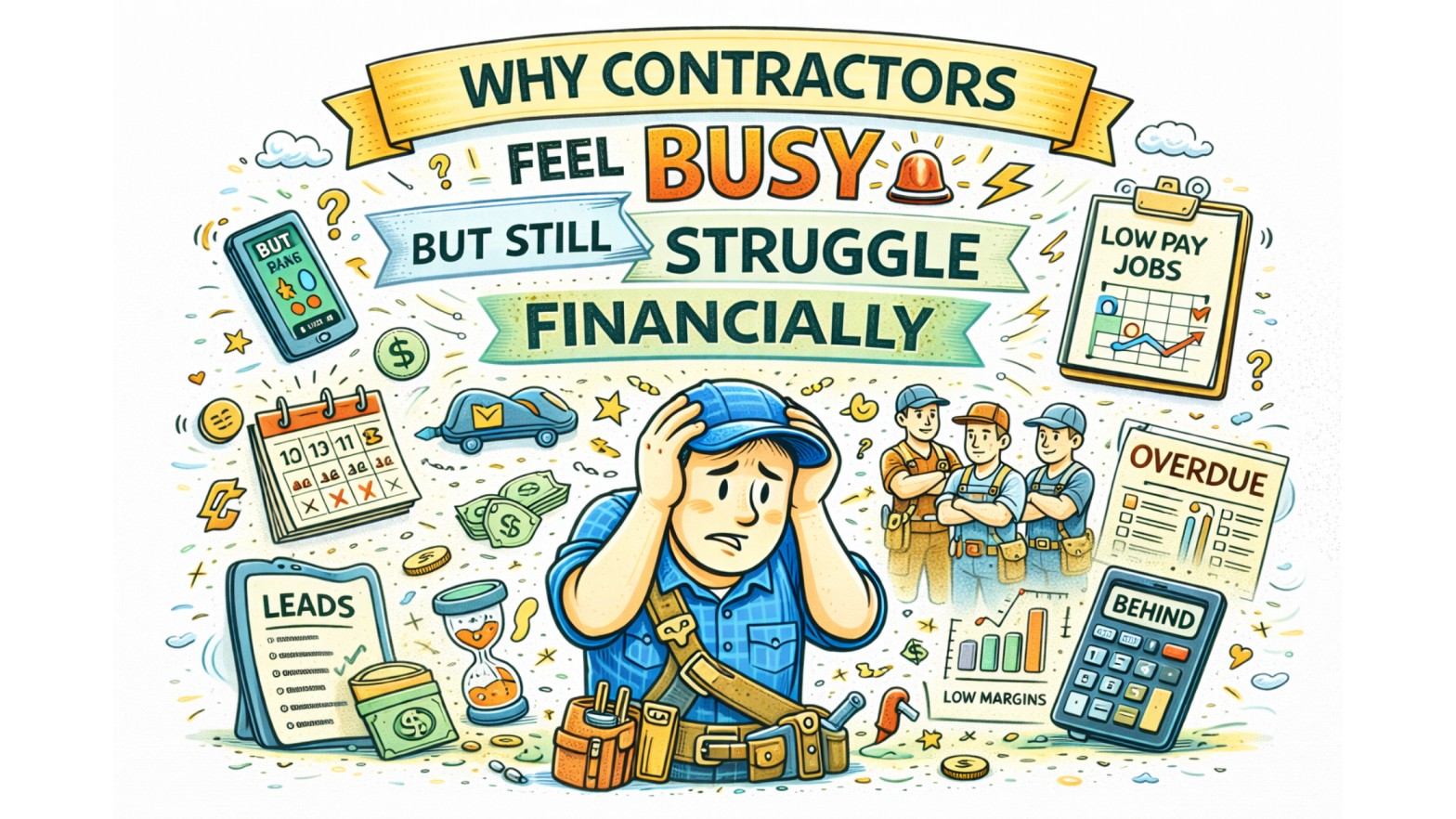
Introduction: The Calendar Is Full. The Bank Account Isn't.
If you're a contractor, this probably sounds familiar:
- Your schedule is packed.
- Your phone keeps ringing.
- You're working long days.
- You're exhausted.
And yet…
At the end of the month, you're thinking:
"Where did the money go?"
This is one of the most common frustrations in the home service world.
Being busy does not automatically mean being profitable.
Let's break down why this happens, and how to fix it.
1. Activity Is Not the Same as Profit
A full calendar only proves one thing:
You are in demand.
It does not prove:
- You're charging correctly
- Your margins are healthy
- Your overhead is controlled
- Your time is used efficiently
Many contractors chase volume instead of profitability.
They fill every slot without asking:
"Is this job worth my time?"
2. Low-Margin Jobs Multiply Stress
Small jobs aren't bad.
But when your schedule is filled with:
- Underquoted work
- Price-sensitive clients
- Short service calls with long travel time
- High-effort, low-return jobs
You're trading time for stress, not income.
Busy becomes chaotic.
Chaotic becomes draining.
Draining becomes burnout.
3. Hidden Time Leakage
Contractors often underestimate non-billable time:
- Driving between jobs
- Picking up materials
- Writing estimates
- Answering calls
- Rescheduling no-shows
- Following up on unpaid invoices
These hours don't show up on invoices.
But they eat your week.
You might "work" 50 hours —
but only bill 25–30.
That gap is where financial frustration lives.
4. Chasing Leads Creates Instability
Many contractors rely heavily on:
- Paid lead platforms
- Bid-based marketplaces
- Emergency calls
- One-off jobs
This creates a feast-or-famine cycle.
When leads slow down:
Stress spikes.
When leads increase:
You overbook.
Neither creates stability.
Stability comes from structured systems, not constant chasing.
5. Constant Bidding Erodes Confidence
If you're regularly competing against:
- 3–5 other contractors
- Faster responders
- Lower bids
- Aggressive discounting
You begin to:
- Doubt your pricing
- Lower your rates
- Accept weaker jobs
- Overwork to compensate
Over time, this chips away at both margin and morale.
6. Poor Customer Retention Forces Constant Restarting
If most of your work comes from new customers,
you're constantly restarting the trust cycle.
That means:
- More selling
- More convincing
- More negotiating
- More explaining
Repeat customers reduce friction.
New customers increase effort.
A business built only on new leads will always feel unstable.
7. No Clear Positioning = Price Competition
If your brand messaging is:
"Reliable. Affordable. Professional."
That's what everyone says.
Without clear positioning:
- You compete on price
- You blend in
- You attract bargain shoppers
When customers choose you for price,
they leave you for price.
8. Mental Load Compounds Over Time
Running a contracting business means you're:
- Technician
- Scheduler
- Salesperson
- Customer service rep
- Accountant
- Operations manager
When income feels inconsistent,
the mental load doubles.
You're not just working hard —
you're thinking constantly.
That invisible stress adds up.
9. The "Busy Trap"
Here's the real trap:
You feel productive.
You feel needed.
You feel in demand.
But you don't feel ahead.
And because you're busy,
you never stop long enough to fix the system.
You just keep running.
10. The Shift That Changes Everything
The contractors who break out of this cycle focus on:
- Better job selection
- Stronger repeat systems
- Healthier margins
- Structured follow-ups
- Local reputation dominance
- Platform diversification (not dependence)
They move from:
"How do I get more jobs?"
To:
"How do I get better jobs consistently?"
That shift reduces pressure instantly.
Where Platforms Fit In (Without Making Them the Problem)
Platforms themselves aren't the villain.
But if a platform:
- Forces bidding
- Promotes price wars
- Charges heavy fees
- Encourages speed over quality
It contributes to the busy-but-broke cycle.
Contractor-friendly marketplaces, where you choose work and protect margins, support stability rather than churn.
The goal isn't avoiding platforms.
It's choosing ones aligned with long-term business health.
The Bottom Line
If you feel busy but financially strained, you don't need:
More stress.
More random jobs.
You need:
Better positioning.
Better job selection.
Better retention.
Busy is not the goal.
Sustainable, controlled growth is.
And it means planning for the predictable slow seasons before they arrive, not scrambling once the calendar goes quiet.
Frequently asked questions
Why am I busy all the time but still not making money?
A packed calendar only proves demand exists, not that your margins are healthy. Low margin jobs create stress rather than income, so activity and profitability are two different things. The shift the post recommends is moving from asking how to get more jobs to asking how to get better jobs consistently.
How much of a contractor's working day is actually unpaid?
Non billable time such as driving, estimates, and admin often consumes 40 to 50 percent of work hours. That means roughly half your day can generate no revenue while still costing you energy. If you price only the hours spent on site, that unpaid half quietly erodes whatever margin the job had.
What is the busy trap that contractors fall into?
The busy trap is staying too busy to fix the problems that keep you busy. When every day is full, there is no room to improve pricing, systems, or job selection, so the underlying issues never get addressed. The schedule looks like success while the margins stay thin.
Why does generic marketing hurt my pricing?
Positioning yourself as "Reliable. Affordable. Professional." says nothing that separates you from every other contractor, so customers fall back on price to decide. Constant bidding against competitors then erodes your pricing confidence over time. Specific positioning gives customers a reason to pick you that is not the number at the bottom of the quote.
What should I focus on instead of just taking on more work?
Focus on better job selection, stronger repeat customer systems, healthier margins, structured follow ups, local reputation, and diversifying where your work comes from. Repeat customers matter most because you are not re selling yourself every time. As the post puts it, busy is not the goal. Sustainable, controlled growth is.