Introduction: Most Contractor Failures Are Preventable
When a contractor shuts down, people assume:
- "The market must have been slow."
- "Too much competition."
- "The economy."
But in most cases, that's not the real reason.
Contractor businesses rarely fail because there's no demand.
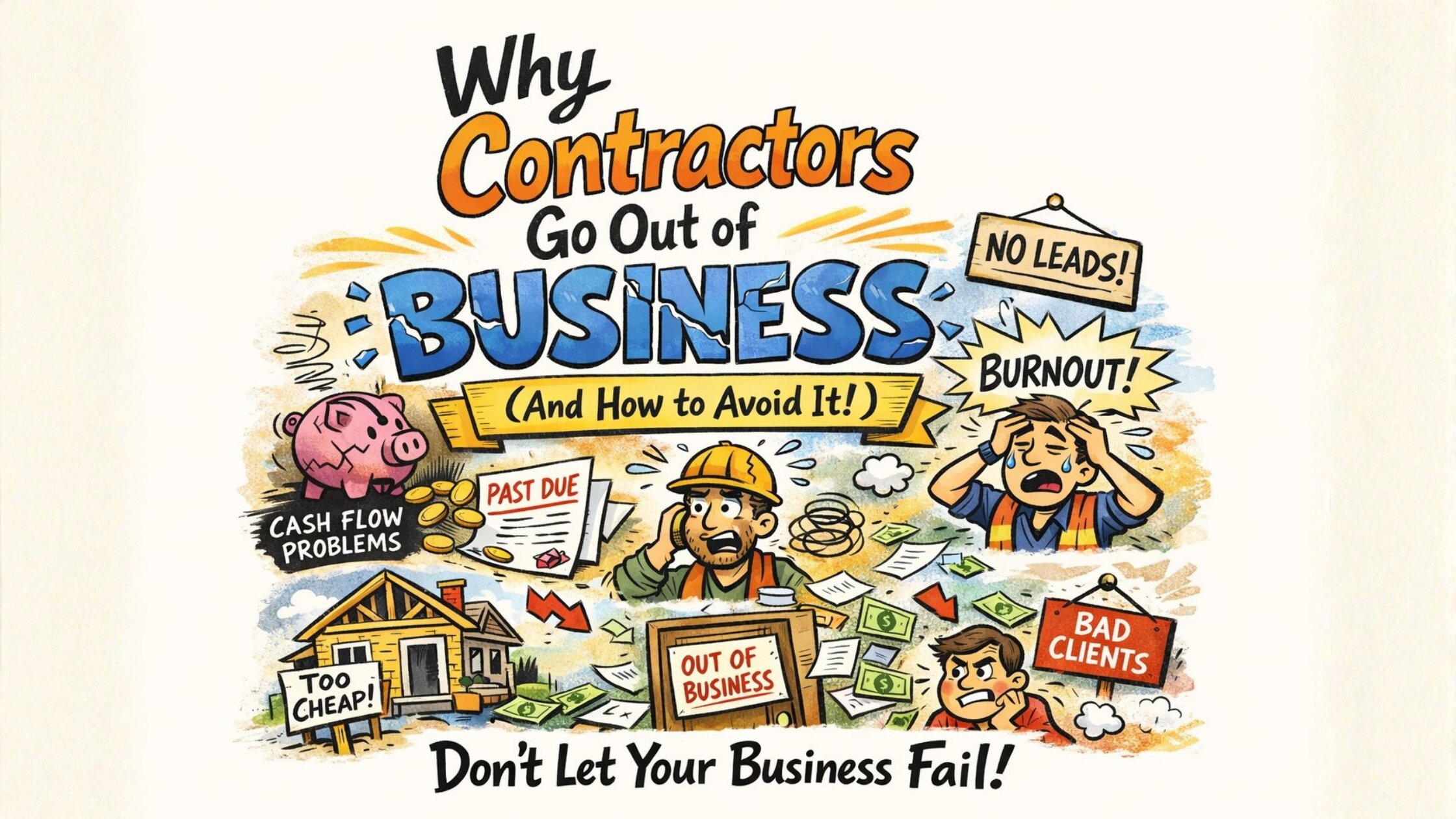
They fail because of:
- Financial mismanagement
- Poor pricing
- Weak systems
- Burnout
- Overexpansion
- Dependency on unstable lead sources
The truth?
Most failures are slow, silent, and predictable.
Let's break down why contractors go out of business, and how to avoid each trap.
1. Cash Flow Mismanagement
This is the #1 killer.
Contractors often:
- Underestimate expenses
- Forget about tax reserves
- Overspend during busy months
- Don't track profit properly
- Mix personal and business finances
Revenue is not profit.
And profit is not cash.
Many contractors look busy, see money flowing in, and assume everything is fine, until:
- A slow month hits
- A large expense appears
- Taxes come due
- A client delays payment
Suddenly, pressure spikes.
Without cash reserves, even strong businesses collapse.
2. Underpricing to Win Work
Many contractors start by pricing low to get traction.
The problem?
They never raise their rates.
Underpricing leads to:
- High workload
- Low margin
- Constant stress
- No breathing room
- Inability to hire help
Eventually, exhaustion sets in.
When a business requires maximum effort just to survive, it becomes fragile.
3. Overreliance on One Lead Source
Some contractors depend entirely on:
- One marketplace
- One referral partner
- One commercial contract
- One marketing channel
That works, until it doesn't.
If a platform:
- Changes its algorithm
- Raises fees
- Increases competition
- Suspends accounts
Revenue can drop instantly.
Diversification isn't optional.
It's survival strategy.
4. Poor Customer Selection
Not all customers are equal.
Some:
- Always negotiate
- Always complain
- Always delay payment
- Always compare bids
- Always drain time
When your schedule is filled with high-friction clients, you burn out faster.
Better positioning attracts better customers.
Weak positioning attracts chaos.
5. No Systems, Just Hustle
Many contractors run on hustle.
They:
- Schedule manually
- Track jobs loosely
- Don't document processes
- Don't follow up systematically
- Don't review performance monthly
Hustle works short-term.
Systems scale.
Without systems, every problem feels personal and urgent.
With systems, problems become manageable.
6. Burnout (The Silent Killer)
Contractor burnout is real.
Long days.
Physical labor.
Admin at night.
Customer communication nonstop.
Eventually:
- Energy drops
- Motivation drops
- Patience drops
Burnout leads to:
- Mistakes
- Missed appointments
- Poor communication
- Damaged reputation
Reputation damage reduces revenue.
Reduced revenue increases stress.
Stress accelerates burnout.
It's a cycle.
7. Growing Too Fast
Ironically, growth can destroy contractors.
Hiring too quickly.
Buying equipment too early.
Taking on large jobs without structure.
Scaling without systems.
Fast growth amplifies weak foundations.
If your pricing, scheduling, or cash flow systems are shaky, growth exposes it quickly.
8. Lack of Financial Visibility
Many contractors don't truly know:
- Their effective hourly rate
- Their cost per job
- Their gross margin
- Their net margin
- Their monthly break-even point
Without visibility, decisions are reactive.
Reactive businesses don't last long.
9. Competing Only on Price
If your only competitive edge is "affordable," you're replaceable.
Price-based competition:
- Attracts bargain shoppers
- Encourages undercutting
- Reduces loyalty
- Compresses margins
Value-based positioning:
- Protects pricing
- Attracts serious customers
- Builds long-term stability
The cheapest contractor often works the hardest for the least return.
10. Ignoring Reputation and Branding
In 2026, visibility matters.
Contractors without:
- Reviews
- Professional profiles
- Clear messaging
- Trust signals
Struggle more than before.
Homeowners research heavily.
Commercial clients verify credibility.
If you look unstructured, you lose higher-quality work.
11. Treating the Business Like a Job
This is subtle, but powerful.
Some contractors operate as if they're still employees.
They think:
- In hours worked
- In weekly pay
- In short-term cash
But business owners must think:
- In systems
- In positioning
- In retention
- In diversification
- In long-term sustainability
Mindset shift matters.
12. The "Busy Trap"
This is common.
The schedule is full.
The phone rings.
The days are long.
But profit isn't consistent.
Being busy hides structural problems.
By the time contractors realize margins are thin, reserves are low.
And recovery becomes harder.
Where Platforms Fit Into This
Platforms are not inherently the problem.
But when contractors rely exclusively on:
- Commission-heavy marketplaces
- Bidding wars
- Race-to-the-bottom pricing
They weaken margin stability.
Healthier contractor ecosystems are built on:
- Direct customer relationships
- Repeat business
- Controlled job selection
- Margin-friendly marketplaces
Platforms should support growth, not replace strategy.
How to Avoid Becoming Another Statistic
Here's what stable contractors do differently:
- Track numbers monthly
- Maintain cash reserves
- Raise rates strategically
- Diversify lead sources
- Build repeat systems
- Protect their energy
- Improve positioning
- Avoid toxic clients
They focus on structure over hustle.
The Bottom Line
Contractors rarely go out of business because there's no work.
They go out of business because:
- They worked too much for too little.
- They didn't see the numbers clearly.
- They burned out.
- They depended on unstable systems.
The solution isn't "more work."
It's:
Better pricing.
Better positioning.
Better energy management.
Longevity is built intentionally.
Frequently asked questions
What is the number one reason contractors go out of business?
Cash flow mismanagement. Contractors confuse revenue with profit and operate without reserves for slow periods, unexpected expenses, and tax obligations. Money moving through the business gets mistaken for money the business is making. Stable contractors track finances monthly and hold a cash reserve so a slow month is an inconvenience rather than an ending.
Why is relying on one source of leads so risky?
Depending on a single marketplace, referral partner, or contract puts your entire income under someone else's control. An algorithm change or a fee increase can remove most of your work overnight, with no warning and no say in it. Diversifying where work comes from means no single change can end the business.
Can a contractor fail even when the schedule is completely full?
Yes, and the post calls this the busy trap. A full schedule masks thin margins and low reserves until the point where recovery becomes difficult. Because the calendar looks healthy, the warning signs get ignored. Profit per job and cash on hand tell you far more about survival than how booked you are.
What financial numbers should a contractor actually be tracking?
Track your effective hourly rate, cost per job, and break even point. Without those, every decision becomes reactive, because you cannot tell which work makes money and which quietly costs you. Reviewing them monthly turns pricing and job selection into informed choices rather than guesses.
Does growing too fast cause contractors to fail?
Overexpansion is a common failure point. Hiring quickly, buying equipment early, and scaling without the infrastructure to support it amplifies the weaknesses that already exist. Growth does not fix a broken system, it multiplies it. The post's summary is that longevity is built intentionally, through structure rather than hustle.