Introduction
Here are some facts that should make you aware that 87 percent of buyers read online reviews before hiring a service provider. This is an example of the importance of reviews and ratings in today's market. Regardless of whether you are a homeowner looking to undertake a renovation or a business seeking a contractor you can trust, finding the right vendor is crucial.
Feedback from online sources can provide insight into how customers have felt about your business in the past and help establish trust. In this blog, we will discuss how reviews and ratings can help you find the right way, focus on the risks, and prevent expensive hiring errors. Now we are going to take a close look at the world of smart hiring and customer feedback.
Understanding Reviews And Ratings
The reviews and ratings do not only show numbers. Ratings tend to display satisfaction using stars or points. Written reviews contain information about a customer's experience. Other reviews are verified, meaning the reviewer actually used the service. The others can be generic opinions that are not that reliable. Transparency is key. Critical reviews present both the positive and the negative aspects.
Knowing the distinction between genuine and fake feedback will allow you to make informed choices when selecting a vendor.
Why Reviews Are Crucial When Choosing A Vendor
Online reviews build trust before you even meet a seller. They show quality, professionalism, and reliability. Ignoring reviews is expensive. As an example, one of the homeowners hired a plumber without reviews. The result? Late, poor quality, and unexpected costs. Instead, it is better to read a review in advance and to avoid these problems.
Feedback from the customers is a safety measure. It can help you choose vendors with a proven history, which lowers the chances of service failures.
How Ratings Reflect Vendor Quality
Numerical scores, such as a 5 star system, are a quick summary of performance. The average rating is important; however, recent ratings tell the story. A vendor can generally receive a high rating, but new complaints may indicate that quality is deteriorating. Single ratings are not as important as patterns.
Several reviews indicate that things remain the same, which reflects a reliable service. Following the trends will help you to find genuine, dependable suppliers and those that have just a streak of luck.
Rating Trend Analysis
| Rating Factor | Meaning | Importance |
| Average Score | Overall, long term satisfaction | Provides a baseline |
| Recent Complaints | Potential decline in service quality | Acts as a red flag |
| Pattern/Consistency | Reliability over time | Most important factor |
Tips For Evaluating Reviews And Ratings
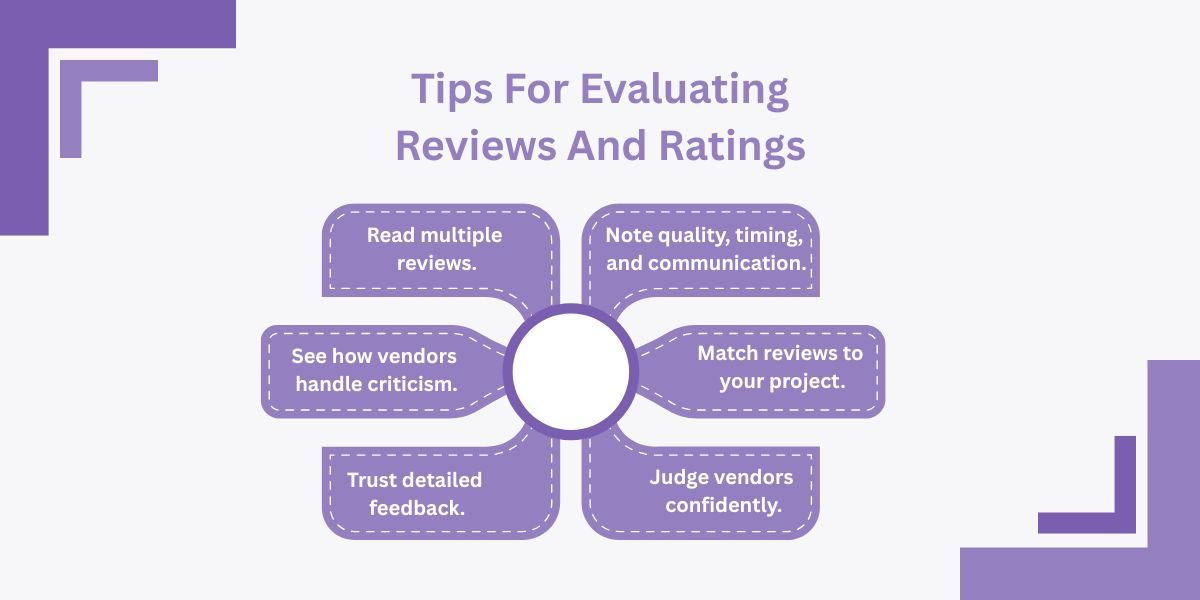
- Choose to read several reviews, not only the first ones you see.
- Look for details about the quality and timeliness of work and communication.
- Observe how vendors respond to negative feedback. A professional vendor handles issues well and demonstrates accountability.
- Determine whether reviews are applicable to your type of project.
- Real feedback, with its details, is much better than overly positive compliments or complaints.
- With these tips, you are able to judge vendors without fear or mistakes.
Leveraging Reviews To Avoid Costly Hiring Mistakes
Feedback on customers is useful in avoiding high spending and contracting unqualified suppliers. Filter through applications using reviews. Pair feedback on interviews or consultations using direct questions. There is a level of information in ratings that serves as the base, but a one on one conversation proves this is correct.
Reviews will give you the opportunity to select a vendor who is both capable and skilled. This two part approach reduces the risk and gets the best results.
Building Confidence Through Customer Feedback
Verified reviews create confidence. They also keep vendors accountable and help maintain a steady quality. Customer feedback will help address the issue of not doing one's homework. Through a close examination of the reviews and ratings, you can have confidence in your hiring choices. You also make sure that your project is running smoothly, on schedule, and within budget.
Conclusion
Ratings and reviews are needed when selecting a vendor. Customer feedback helps create trust and prevent expensive errors. Trends in ratings and detailed reviews provide insight into quality and professionalism. With the effective use of reviews, you make better informed and more confident hiring choices.
FAQs
Can We Trust All Online Reviews?
Not all reviews are real. Find checked reviews and numerous sources. Be aware of too generic remarks.
Should We Consider Vendors With Mixed Reviews?
Yes. Think about the advantages and disadvantages. Mixed reviews can be a sign of a few isolated problems rather than a comprehensive issue.
How Many Reviews Are Enough To Make A Decision?
Volume and recency matter. More reviews show a better image. Recent feedback is an indicator of the present performance.
Do Negative Reviews Always Mean A Bad Vendor?
No. Constructive criticism helps you find reliability. Do not focus on individual incidents, but rather on patterns and red flags.
Frequently asked questions
Why should I check reviews before hiring a vendor?
Reviews act as a safety measure by showing whether a vendor has a proven track record before you commit money. The post notes that 87 percent of buyers read online reviews before engaging a service provider. It gives the example of a homeowner who hired a plumber without checking and faced delays, poor quality work, and unexpected expenses.
What matters more, a vendor's star rating or their written reviews?
Written reviews carry more weight, because a numerical score only summarizes satisfaction over time. Detailed, balanced feedback that mentions both strengths and weaknesses is the most reliable. Verified reviews from people who actually used the service matter more than generic opinions. The rating is a baseline reference. The writing tells you why.
What should I look for when reading vendor reviews?
Read several rather than just the first few, and look for detail on work quality, timeliness, and communication. Check whether reviewers had a project like yours. Watch how the vendor responds to negative feedback, since a professional response demonstrates accountability. Favor balanced, detailed accounts over glowing praise or pure complaint.
Do recent reviews matter more than a vendor's overall average?
Yes. Recent ratings reflect current performance, while an average blends years of history. A high overall score paired with new complaints can signal declining quality. The most important factor is pattern and consistency, meaning reliability demonstrated repeatedly, rather than any single score or one off incident.
Are reviews enough on their own to choose a vendor?
No. Use reviews to filter your shortlist, then verify what you found by speaking with the vendor directly and asking pointed questions. Ratings give you the foundation, but a conversation confirms whether the picture is accurate. Combining both reduces the risk of a costly hire and helps keep projects on schedule and within budget.