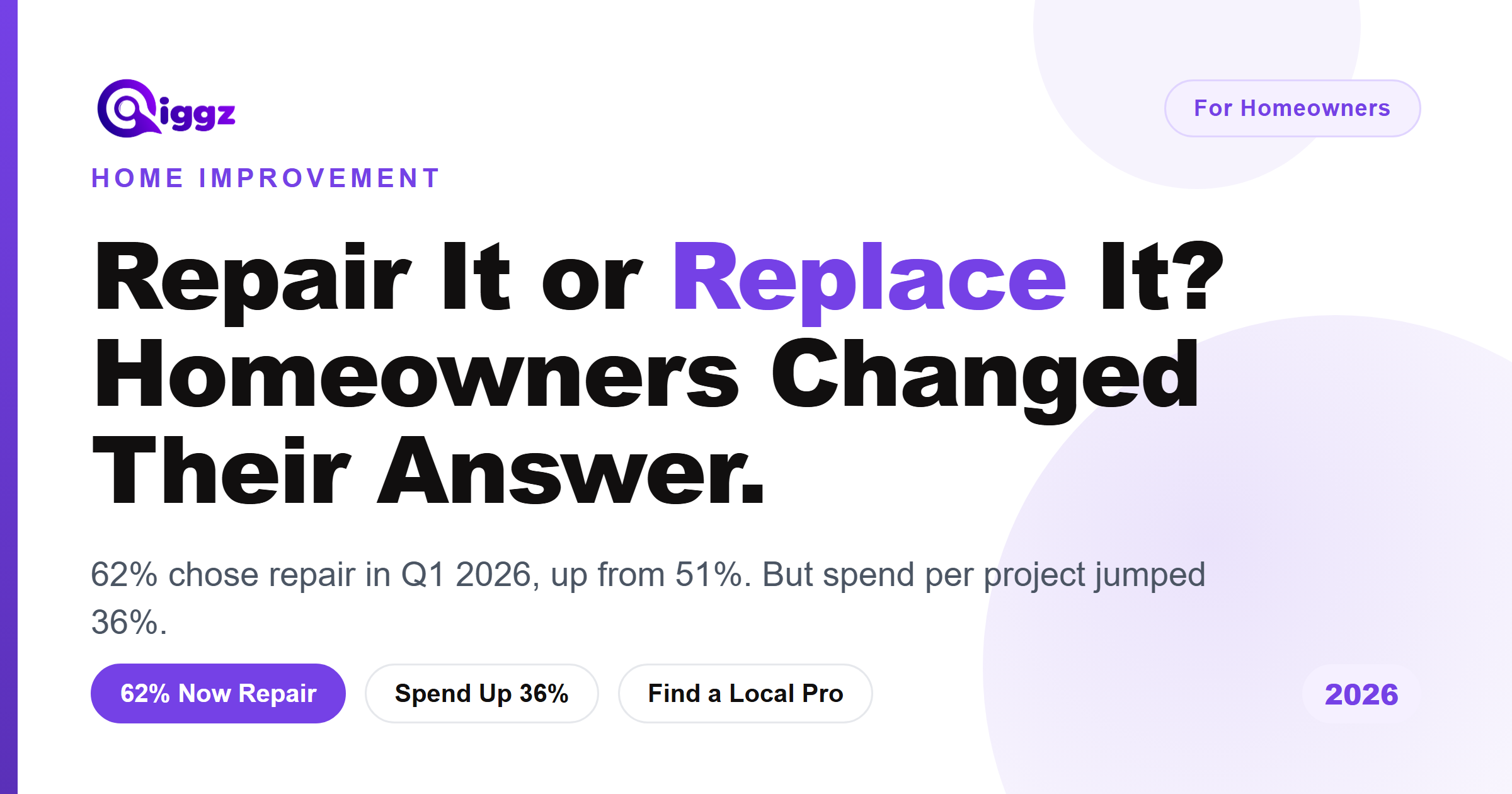
Quick answer: The default flipped in a single quarter. 62% of homeowners chose repair over replacement in Q1 2026, up from 51% in Q4 2025, from a survey of nearly 1,200 homeowners. They aren't spending less though. Average spend per project rose 36%, from $3,957 to $5,368. Fewer projects, chosen harder, done properly.
Consumer behavior rarely moves eleven points in three months. This did.
What changed
In Q4 2025, 51% of homeowners chose repair over replacement. By Q1 2026 it was 62%, from a survey of nearly 1,200 homeowners run across March and April.
Cost pressure is the obvious explanation and it's part of it. Roughly 60% of homeowners say they've put off repairs because of cost, and about 73% are sitting on a backlog of jobs waiting.
But the spending data complicates the simple story. If this were pure belt-tightening, spend per project would fall. It rose sharply, from $3,957 in Q1 2025 to $5,368 in Q1 2026, up 36% year over year. That's not people economising. That's people doing fewer things and committing properly to the ones they pick.
When repair genuinely wins
Repair usually makes sense when the unit is inside its expected service life, the fault is a component rather than the core system, parts are still available, and the repair lands well under about a third of replacement cost.
Replacement usually wins when the system is near end of life anyway, when you're on your third service call, when efficiency gains would cut running costs meaningfully, or when parts have become hard to source.
The trap is the middle. Repeatedly repairing something that's already at the end of its life, where three visits quietly outrun the cost of replacing it, and nobody adds them up because each one felt small at the time.
For the big decisions, our breakdowns on replacing an HVAC system, installing a water heater and replacing a roof give you the replacement side of the comparison.
Who benefits from repair advice
Worth naming something the repair-it-don't-replace-it genre usually skips.
Repair advice isn't automatically neutral. A replacement is one job. A dying unit limping along on service calls can be three or four visits across two years, and for some operators that's the better book of business. Most tradespeople will tell you straight when something is finished, and the good ones talk themselves out of work regularly. But the incentive isn't always pointing where the advice points, and you're allowed to notice that.
Pushing the other way, replacement is also sold hard, sometimes on efficiency savings that take fifteen years to pay back a unit that won't last fifteen years. Both directions have a sales pitch attached.
There's also a genuine shift underneath all this. Plenty of appliances are harder to repair than their equivalents twenty years ago, with sealed assemblies, proprietary parts and boards that cost most of a new unit. Sometimes replace it and move on isn't laziness, it's the only option the manufacturer left you.
The question to ask
Not can you fix it. Ask: how old is this, what's its realistic remaining life, and if I spend this repair money, what am I actually buying in time?
A good tradesperson answers that directly, including when the honest answer costs them the bigger job. That answer is worth more than the estimate.
Get a straight answer from a local pro
Whether repair or replacement is right depends on your specific system, and that needs eyes on it rather than a search result.
Qiggz is a free, US-based marketplace for local trades, with reviews from real customers and no lead fees inflating your quote. Find a local pro, or go direct to an HVAC contractor, a plumber or an electrician.
Frequently asked questions
Are more homeowners repairing instead of replacing?
Yes, and it shifted fast. 62% chose repair over replacement in Q1 2026, up from 51% in Q4 2025, from a survey of nearly 1,200 homeowners conducted in March and April.
If people are repairing more, are they spending less?
No. Average spend per project rose 36% year over year, from $3,957 to $5,368. The pattern is fewer, more considered, higher-value projects rather than simple cost-cutting.
When is repair the better choice?
Generally when the unit is within its expected service life, the fault is a component rather than the core system, parts are available, and the repair costs well under about a third of replacement. Repeat repairs on a system near end of life are usually the worse economic call.
Can I trust a contractor who recommends repair?
Usually, and most will tell you honestly when something is finished. Just be aware the incentives aren't always neutral in either direction: a dying unit can mean several service calls, while replacement is sometimes sold on efficiency savings with an unrealistic payback period. Ask for the remaining-life estimate and judge the reasoning.
Why does replacement sometimes seem like the only option?
Because for many modern appliances it is. Sealed assemblies, proprietary parts and control boards costing nearly as much as a new unit have made some products genuinely uneconomic to repair.
Why are homeowners delaying projects?
Cost mainly, with roughly 60% saying they've put off repairs because of it, and around 73% reporting a backlog of jobs waiting.
Sources
- 62% choosing repair over replacement in Q1 2026 versus 51% in Q4 2025, from a survey of nearly 1,200 homeowners conducted March to April, and average project spend rising 36% from $3,957 to $5,368: Home Improvement Research Institute (HIRI), as reported by Hardware Retailing, 2026.
- Roughly 60% of homeowners putting off repairs due to cost: Today's Homeowner survey, 2026.
- Around 73% of homeowners reporting a backlog of waiting projects: Angi, 2026.
- Qiggz no lead fees positioning: first-party (Qiggz product); see /signup.