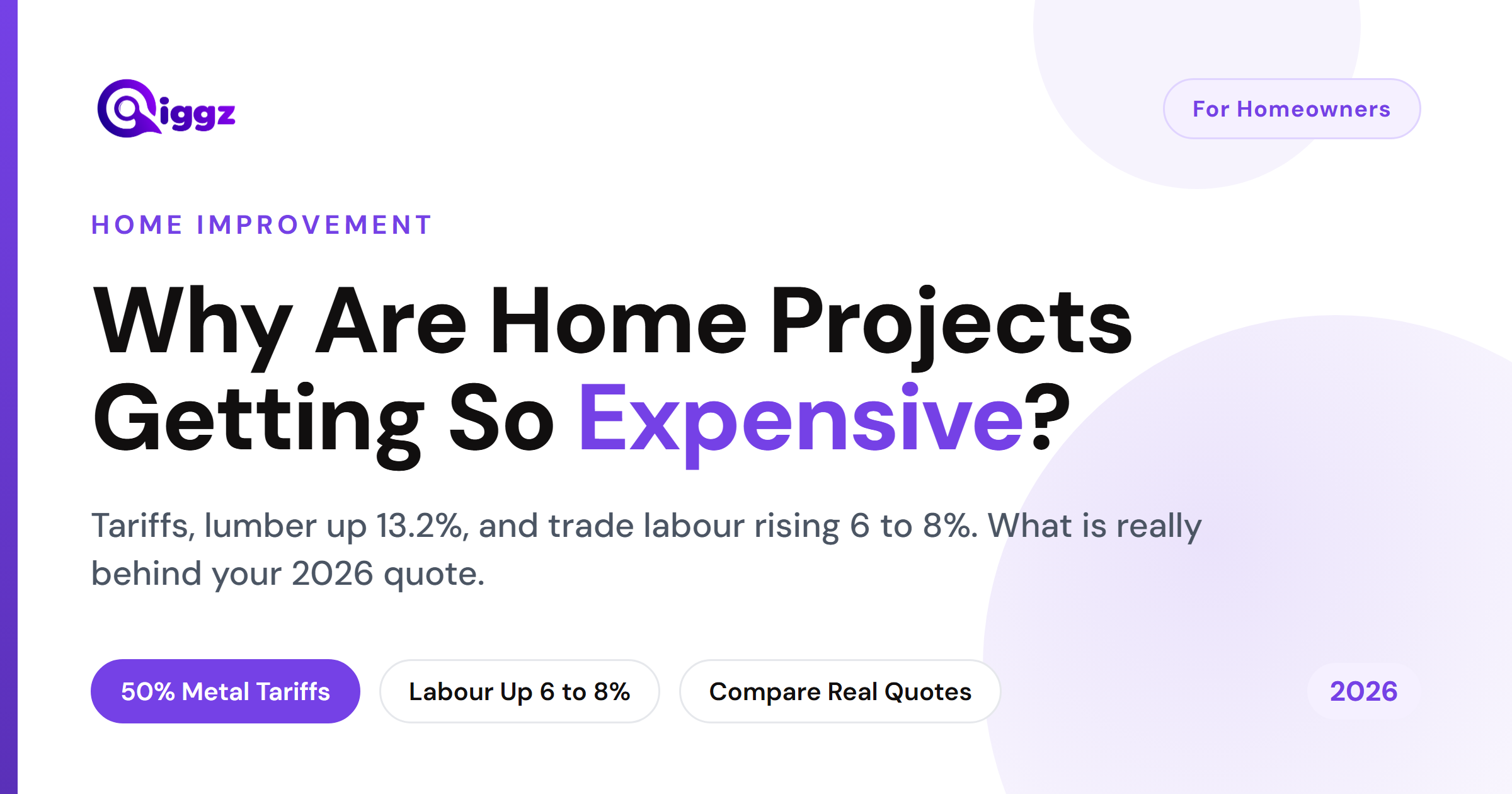
Quick answer: Mostly not your contractor. Materials are up 4% to 6% on average with tariff-hit goods far higher, steel, aluminum and copper carry 50% tariffs, aluminum mill shapes are up 44.8% cumulatively and softwood lumber 13.2% year over year. Trade labor is up a further 6% to 8%. Around 72% of remodelling contractors say they're raising rates to cover costs rather than to widen margins.
A quote comes in higher than you expected and the natural thought is that someone's trying it on. The 2026 cost data doesn't really support that.
Where the money actually went
Two pressures are stacking, and they have different causes.
The first is materials, up 4% to 6% on average, with far sharper moves on anything tariff-exposed. Steel, aluminum and copper carry 50% tariffs, with 25% on derivative products. Aluminum mill shapes are up 44.8% cumulatively. Softwood lumber climbed 13.2% year over year through April 2026. Those inputs sit inside nearly every structural, roofing, plumbing and electrical job in the country.
It's worth naming that plainly rather than calling it market conditions. A meaningful slice of what you're being quoted is tariff policy arriving at your house. You can hold whatever view you like about whether those tariffs are worth it, but the cost is not a mystery and it isn't your contractor's doing.
The second pressure is labor, up 6% to 8%, and this one has nothing to do with trade policy.
The labor half is a twenty year old bill
Trade labor is expensive right now because there aren't enough tradespeople, and that shortage was not an accident of 2026.
Apprenticeship training is a cost an individual firm carries for years, after which the newly licensed worker can walk to a competitor who paid nothing. So most firms didn't train, everyone assumed someone else would, and the retirement wave that had been visible for two decades arrived on schedule to find no replacements behind it.
Now data centers are bidding for the same electricians, which pushes the price up again. That's the part of your quote that isn't coming back down, tariffs or no tariffs.
What contractors say they're doing
The industry data suggests pass-through rather than opportunism. Around 72% of residential remodelling contractors report raising rates to keep pace with costs, naming materials, labor and inflation. About 77% describe themselves as optimistic about 2026, which tells you demand is holding even as prices climb.
So a higher quote in 2026 is more likely to reflect real input costs than someone chancing it. That doesn't mean every quote is fair. It means the benchmark genuinely moved, and comparing this year's number to your memory of 2021 will mislead you.
Telling a fair quote from a padded one
The defense isn't haggling. It's paperwork.
Get it itemized. Materials, labor, permits, disposal, overhead, separately. A single lump number can't be compared against anything.
Get three. Not to take the cheapest, but because three itemized quotes reveal the actual local rate for your job. The outlier is the useful signal, in either direction.
Ask what moved on materials. A contractor pricing from cost can tell you specifically which inputs jumped. One who can't may be pricing from hope.
Be suspicious of the low bid. When input costs are moving this fast, a quote well under the others usually means something was left out, and it'll come back as a change order. What every contractor contract must include covers how to close that door.
Compare real local quotes, without a lead fee inside them
One cost you can remove entirely never appears on the quote. On platforms charging pros per lead, that fee is built into what you pay.
Qiggz is free for tradespeople, so nothing is added to your price to cover the cost of them finding you. Find local pros and compare quotes, or read our guide to hiring the right contractor.
Frequently asked questions
Why did my renovation quote jump in 2026?
Materials are up 4% to 6% on average with tariff-affected goods much higher, since steel, aluminum and copper carry 50% tariffs and aluminum mill shapes are up 44.8% cumulatively, while softwood lumber rose 13.2% year over year. Trade labor is separately up 6% to 8% because of the skilled trades shortage.
Are contractors overcharging?
The data points to cost pass-through. Around 72% of residential remodelling contractors report raising rates specifically to match rising material, labor and inflation costs rather than to widen margins.
Do tariffs really affect home renovation costs?
Directly. Steel, aluminum and copper carry 50% tariffs with 25% on derivatives, and those metals appear throughout structural, roofing, plumbing and electrical work. Aluminum mill shapes are up 44.8% cumulatively.
Why is trade labor so expensive now?
Because there aren't enough tradespeople. Apprenticeship training is a cost individual firms carry while competitors can poach the result, so the industry under-trained for two decades and the predictable retirement wave arrived with no pipeline behind it. Data center demand has since added more competition for the same workers.
How do I know a quote is fair?
Get it itemized into materials, labor, permits, disposal and overhead, and get three for the same scope. Three itemized quotes reveal the real local rate. Treat anything far below the others with caution, because it usually means something was excluded and will return as a change order.
Will these costs come down?
Material prices may ease, and some 2026 analyses describe them as roughly flat year over year. The labor component is structural and unlikely to reverse quickly.
Sources
- Material increases of 4% to 6%, 50% tariffs on steel, aluminum and copper with 25% on derivatives, aluminum mill shapes up 44.8% cumulatively, and softwood lumber up 13.2% year over year through April 2026: Angi building materials price analysis and 2026 construction cost reporting.
- Labor costs rising 6% to 8% on workforce scarcity: 2026 contractor cost and pricing analyses.
- 72% of remodelling contractors raising rates to match costs, 77% optimistic about 2026, and homeowner improvement spending around $522 billion: Acorn Finance renovation market analysis and 2026 contractor pricing surveys.
- 63% of homeowners citing rising material costs as their top renovation concern: 2026 homeowner survey reporting.
- Qiggz free-for-pros pricing model: first-party (Qiggz product); see /signup.