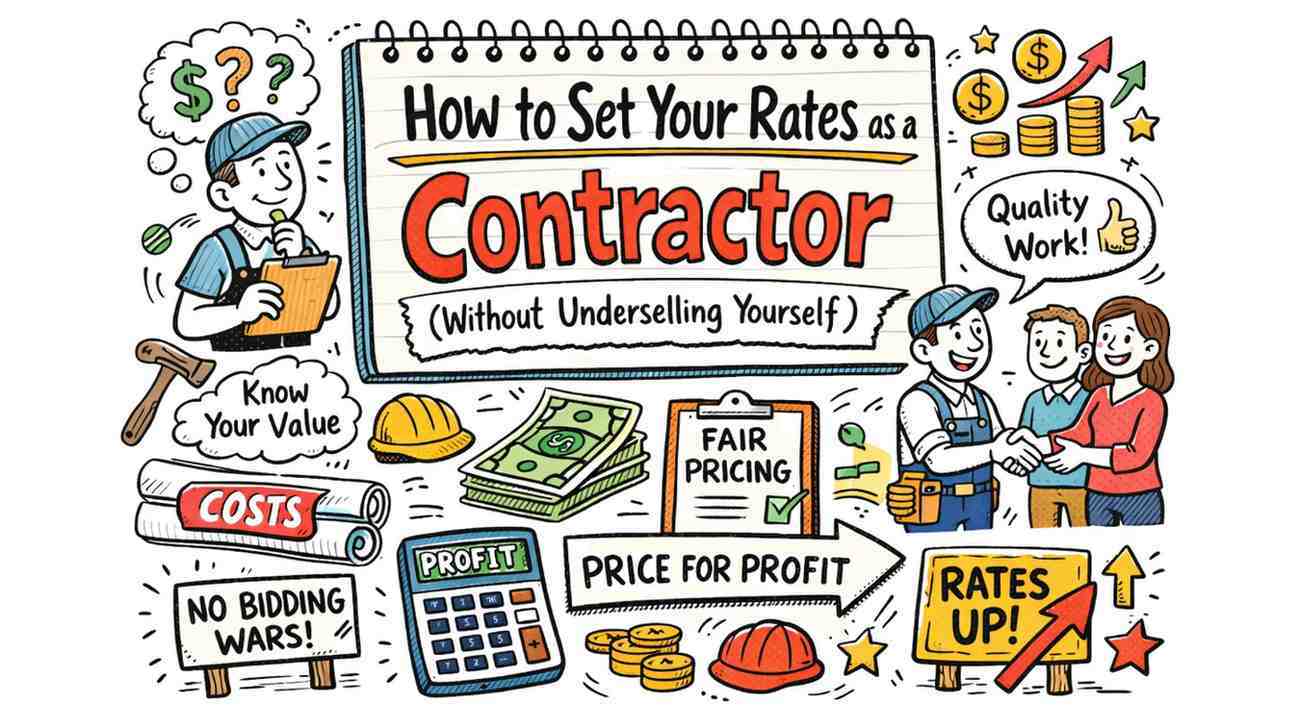
Introduction: The Pricing Problem Most Contractors Don't Talk About
Ask ten contractors how they price their work, and you'll get ten different answers.
Some charge:
- "What the last guy charged"
- "Whatever the customer seems willing to pay"
- "Just enough to win the job"
- "A little more than materials"
This is exactly why so many skilled contractors feel overworked, underpaid, and stuck.
Underselling isn't a pricing issue, it's a system issue.
If you don't understand your real costs, your value, and your market, you'll always feel pressure to lower your price just to stay busy.
This guide will show you how to:
- Set contractor rates with confidence
- Cover all your costs (not just materials)
- Stop racing to the bottom on price
- Attract better clients who respect your work
1. Why Most Contractors Undersell Themselves
Let's be honest, contractors don't underprice because they want to.
They underprice because of:
- Fear of losing the job
- Inconsistent work
- Platform bidding wars
- Poor cost visibility
- Pressure from cheaper competitors
Many contractors think:
"If I charge more, I'll lose work."
In reality:
If you charge too little, you attract the worst work.
Low prices often mean:
- More negotiation
- More scope creep
- Less respect
- More stress
- Less profit
Underselling is not survival, it's slow burnout.
2. Start With the Truth: Your Real Cost of Doing Business
Before setting rates, you must know your true cost.
Most contractors only think about:
- Materials
- Fuel
- Maybe labor
That's not enough.
Your real costs include:
- Materials & supplies
- Labor (including your own time)
- Insurance (general liability, workers comp)
- Licensing & permits
- Vehicle costs (fuel, maintenance, depreciation)
- Tools & equipment (purchase + wear & tear)
- Marketing & advertising
- Software, phones, internet
- Taxes (this one hurts if ignored)
- Time spent quoting, driving, and admin
If you don't price these in, you're paying out of pocket to work.
3. Hourly Rate vs Project Pricing (What Actually Works)
Many contractors struggle choosing between hourly and flat pricing.
Hourly Pricing – Pros & Cons
Pros
- Simple to calculate
- Protects against unknowns
Cons
- Homeowners hate uncertainty
- Caps your earning potential
- Punishes efficiency
Hourly pricing often undervalues skilled contractors who work faster because of experience.
Project-Based Pricing – Pros & Cons
Pros
- Clear expectations
- Higher earning potential
- Rewards efficiency
- Easier for clients to approve
Cons
- Requires better estimating
- Risk if scope isn't defined
Best practice:
Use project pricing for standard jobs and hourly rates only for diagnostics or unknown issues.
4. How to Calculate a Profitable Contractor Hourly Rate
Even if you price by project, you still need an internal hourly benchmark.
Step-by-step method:
- Decide your annual income goal
Example: $100,000 - Add annual business expenses
Example: $40,000 - Total required revenue
$140,000 - Estimate billable hours per year
Realistically: 1,500–1,700 hours (not 2,000) - Divide revenue by billable hours
$140,000 ÷ 1,600 = $87.50/hour
This is your minimum viable rate.
Charging less means you're losing money long-term.
5. Why "Market Rates" Are a Trap
Many contractors ask:
"What are other contractors charging?"
Here's the problem:
- You don't know their costs
- You don't know their quality
- You don't know if they're profitable
The cheapest contractors are often:
- New
- Desperate
- Overworked
- Burning out
You don't want to compete with failing businesses.
Instead, price based on:
- Your experience
- Your reliability
- Your professionalism
- Your risk reduction for the client
6. Price for Risk, Not Just Labor
Contractors carry risk.
You're responsible for:
- Safety
- Compliance
- Quality
- Callbacks
- Mistakes
Clients aren't just paying for labor, they're paying for:
- Peace of mind
- Accountability
- Experience
- Insurance-backed work
If something goes wrong, you fix it, not the homeowner.
That risk must be priced in.
7. Stop Explaining Your Price, Explain Your Value
One of the biggest mistakes contractors make is defending their price.
Instead of:
"I charge more because materials are expensive"
Say:
"My price includes quality materials, clean installation, warranty-backed work, and reliable timelines."
Confident pricing doesn't need justification, it needs clarity.
8. Why Cheap Clients Are the Most Expensive
Low-paying jobs usually come with:
- Endless changes
- Late payments
- Micromanagement
- Bad reviews
- No referrals
Higher-paying clients:
- Respect your time
- Approve faster
- Leave better reviews
- Refer better customers
Raising your rates often improves your client quality.
9. How Platforms Influence Your Pricing Power
Many contractors lose pricing power because of where they find work.
Platforms that rely on:
- Open bidding
- Paid leads
- Unlimited vendor competition
Push contractors to underprice just to be seen.
That's why more contractors are shifting to Qiggz.
Why Qiggz helps contractors price fairly:
- No bidding wars
- Limited vendor exposure per job
- Direct homeowner communication
- No commissions
- Jobs come to you, not the cheapest bidder
When you're not forced to race to the bottom, you can charge what your work is actually worth.
10. How to Raise Your Rates (Without Losing Work)
Afraid to increase prices? Do it strategically.
Smart ways to raise rates:
- Increase prices for new customers first
- Add value (warranty, cleanup, priority scheduling)
- Improve response time & professionalism
- Specialize further
- Stop taking low-margin jobs
Most contractors are surprised how few clients push back.
11. Reviews Make Higher Pricing Easier
Social proof reduces price sensitivity.
Contractors with:
- Strong reviews
- Photos of past work
- Clear communication
Get hired faster, even at higher rates.
People don't want the cheapest contractor. They want the least risky one.
12. When to Walk Away From a Job
Not every job is worth taking.
Red flags:
- Immediate price pressure
- "Just a quick favor"
- Unrealistic timelines
- Disrespectful communication
- Scope without clarity
Walking away protects your pricing integrity and your sanity.
13. Pricing Is a Business Skill, Not a Guess
Great contractors learn their trade. Great businesses learn pricing.
Pricing is not:
- Greed
- Arrogance
- Luck
It's a calculated decision that keeps your business alive.
The Bottom Line
If you're constantly busy but still stressed about money, your pricing is broken.
Setting contractor rates properly means:
- Knowing your real costs
- Pricing for risk and value
- Avoiding platforms that force underpricing
- Attracting clients who respect your work
When you stop underselling yourself, everything improves:
- Your income
- Your schedule
- Your clients
- Your reputation
Want jobs where you don't have to undercut just to win?
Join Qiggz and connect directly with homeowners, no bidding wars, no commissions, no middlemen.
Frequently asked questions
How do I calculate my hourly rate as a contractor?
Add your target income to your business expenses, then divide by realistic billable hours. The example in the post: a $100,000 income goal plus $40,000 of expenses equals $140,000 of required revenue. Divide that by 1,500 to 1,700 billable hours a year and you get $87.50 an hour as the minimum viable rate.
Why should I not use 2,000 hours when working out my rate?
Because you do not bill 2,000 hours. Quoting, driving, and admin all consume time you cannot invoice, which is why a realistic figure is 1,500 to 1,700 billable hours a year. Dividing by 2,000 makes your rate look adequate on paper while quietly guaranteeing you come up short.
What costs should I build into my rates?
All of them, not just materials and labor. That means insurance including general liability and workers comp, licensing and permits, vehicle costs covering fuel, maintenance and depreciation, tools and equipment, marketing and advertising, software, phones and internet, taxes, and the time you spend quoting, driving, and doing admin.
Should I charge hourly or price by the project?
Project pricing generally serves you better. An hourly rate caps your earning potential, because the only way to earn more is to work more hours. Project pricing rewards efficiency and carries higher earning potential: when you get faster or smarter, you keep the gain instead of billing less for it.
Why do contractors undersell themselves?
Fear, mostly. Fear of losing the job, inconsistent work, platform bidding wars, no clear view of true costs, and pressure from what competitors appear to charge. The trap is that low prices attract the worst work, and thin margins combined with demanding clients turn into a slow burnout.