Introduction: Busy Doesn't Always Mean Successful
Many contractors take pride in being busy. Your phone rings. Your calendar is full. Work never seems to stop. Yet somehow:
- You're always tired
- Money feels tight
- One slow week causes stress
- Every quote feels like a negotiation
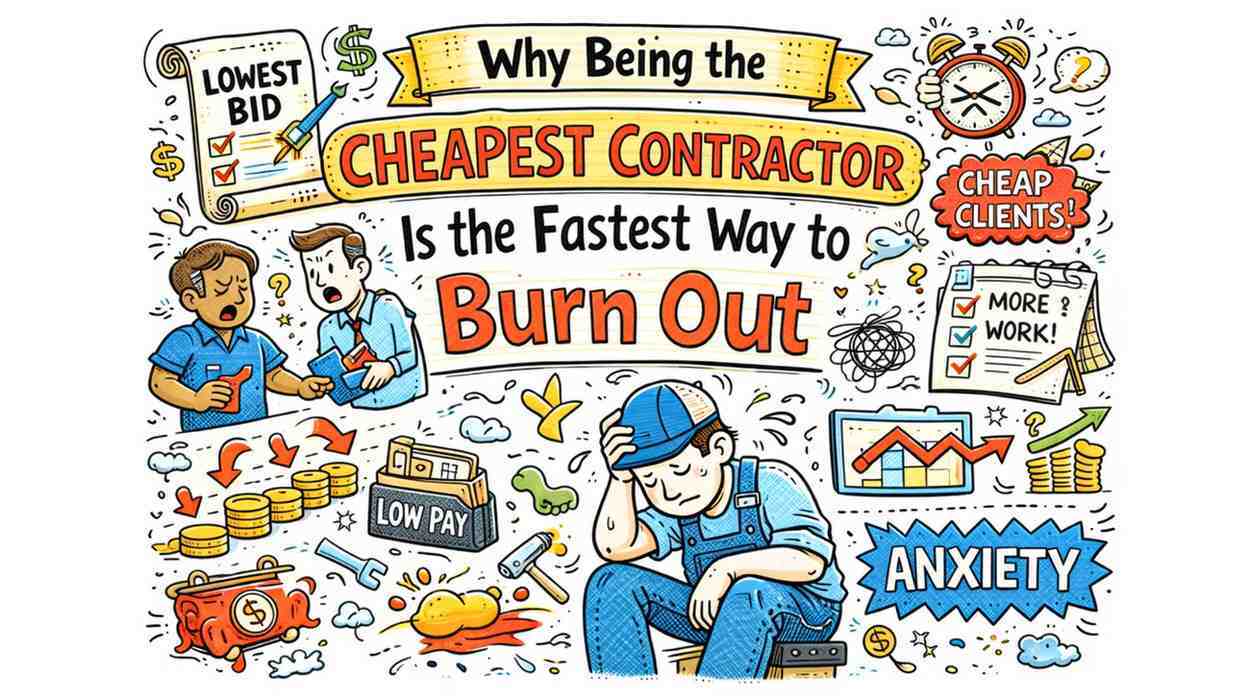
This is one of the most common contractor traps in the US: You're busy—but you're burning out. And in most cases, the root cause is simple: You've built your business around being the cheapest option. This article explains why that strategy fails—and how it quietly destroys otherwise great contractor businesses.
1. Cheap Pricing Creates Endless Pressure
When you price low, you don't buy yourself peace—you buy yourself pressure. Low margins mean:
- You must work more hours to earn the same income
- Every delay hurts
- Every callback feels expensive
- Every slow period becomes stressful
There's no buffer. You can't slow down. You can't say no. You can't afford mistakes. That constant pressure is the foundation of burnout.
2. Cheap Jobs Attract the Hardest Clients
Price-sensitive customers are not "value-driven." They're risk-driven. They worry about:
- Every dollar
- Every change
- Every invoice
And that usually shows up as:
- Constant negotiating
- Scope creep
- Micromanagement
- Late payments
- Poor communication
Ironically, the cheapest jobs often demand the most emotional energy. Better-paying clients usually:
- Decide faster
- Trust your expertise
- Respect boundaries
- Leave better reviews
Burnout isn't caused by work alone—it's caused by bad work.
3. Undercutting Punishes Skill and Experience
When you compete on price, experience stops mattering. Ten years in the trade? Advanced certifications? Licensed and insured? None of that helps when the only comparison point is who's cheaper. This creates a brutal dynamic:
- Skilled contractors earn the same as beginners
- Efficiency is punished
- Quality becomes invisible
Over time, this makes even experienced contractors feel:
- Undervalued
- Replaceable
- Frustrated
That emotional erosion is a major burnout driver.
4. Low Pricing Forces You to Say Yes to Everything
When margins are thin, you can't afford to be selective. You take:
- Jobs outside your specialty
- Poorly scoped work
- Rushed timelines
- Clients who don't respect you
Not because you want to—but because you feel you have to. This destroys:
- Work-life balance
- Focus
- Pride in craftsmanship
Burnout thrives where boundaries don't exist.
5. Being the Cheapest Traps You in a Volume Game
Low pricing only works at high volume. That means:
- More jobs
- More driving
- More admin
- More stress
Every additional job adds complexity—but not proportional income. Eventually:
- You're always behind
- You're always exhausted
- You feel like you're running on a treadmill
Volume without margin is not growth. It's exhaustion disguised as success.
6. Cheap Pricing Makes Slow Seasons Brutal
All contractors face slow periods. But cheap contractors feel them the hardest. Why?
- No financial cushion
- No maintenance plans
- No repeat-customer buffer
- No pricing flexibility
One quiet week turns into panic. Burnout isn't just about working too much—it's about never feeling secure.
7. The Market Pushes Contractors Toward Cheap Pricing
Many contractors don't choose this path willingly. They're pushed into it by:
- Bidding platforms
- Pay-per-lead systems
- Unlimited vendor competition
- Algorithms that reward the lowest price
These systems train homeowners to shop on price—and contractors to race to the bottom. That's why more contractors are actively seeking alternatives like Qiggz. Why this matters:
- No bidding wars
- No commissions
- Direct homeowner communication
- Limited competition per job
When price isn't the only filter, contractors regain control—and reduce burnout.
8. Cheap Pricing Erodes Pride in Your Work
Most contractors take pride in craftsmanship. But when you're rushed, underpaid, and stressed:
- Details get skipped
- Work becomes transactional
- Satisfaction fades
Over time, you stop enjoying the work—not because you hate the trade, but because the system makes it miserable. Burnout often begins when pride disappears.
9. The Emotional Cost Nobody Talks About
Burnout isn't just physical. It shows up as:
- Irritability
- Constant anxiety
- Difficulty switching off
- Guilt when resting
- Resentment toward work
Many contractors feel trapped: "If I charge more, I'll lose work." "If I don't take this job, what if nothing else comes?" That mental loop is exhausting.
10. Raising Prices Doesn't Lose Good Clients—It Filters Them
One of the biggest myths in contracting is: "If I raise prices, I'll lose customers." What usually happens instead:
- You lose the worst customers
- You attract better ones
- Jobs get easier
- Stress decreases
Higher pricing creates:
- Better communication
- Faster decisions
- More respect
Burnout decreases when your work environment improves.
11. Burnout Is a Business Signal, Not a Personal Failure
Many contractors blame themselves. They think:
- "I'm not tough enough"
- "Everyone else handles this"
- "This is just how it is"
That's not true. Burnout is a signal that:
- Pricing is wrong
- Job sources are broken
- Systems are missing
Fixing the business fixes the burnout.
12. Sustainable Contractors Play a Different Game
Contractors who last:
- Price for sustainability
- Choose better job sources
- Focus on repeat work
- Set boundaries
- Protect their energy
They're not lazy. They're strategic. And they're still busy—just not exhausted.
The Bottom Line
Being the cheapest contractor:
- Doesn't build loyalty
- Doesn't create stability
- Doesn't lead to long-term success
It leads to:
- Burnout
- Stress
- Resentment
- Short careers
If you're constantly tired, stressed, and underpaid, the issue isn't effort—it's strategy.
👉 If you want work without racing to the bottom, use platforms that don't reward underpricing—like Qiggz, where contractors connect directly with homeowners without bidding wars or commissions.
Frequently asked questions
Why does being the cheapest contractor lead to burnout?
Low prices force you to work more hours to earn the same income, so the pressure never lets up. Thin margins also remove your ability to turn down bad jobs, which means working outside your specialty and rushing timelines. The model only functions at high volume, so exhaustion arrives before growth does.
Do cheaper clients actually cause more problems than higher paying ones?
Yes. Price sensitive customers tend to demand more emotional labor through negotiation, scope creep, and micromanagement. Higher paying clients generally decide faster and treat your time with more respect. The discount you offer often gets paid back to you in stress rather than in loyalty or repeat work.
Why doesn't my experience or licensing help me when I compete on price?
When price is the only comparison point, credentials stop mattering. Ten years in the trade, advanced certifications, and being licensed and insured all become invisible if the customer is only asking who is cheaper. Undercutting erases the very advantages that should let you charge more.
If I raise my prices, won't I just lose the work?
Raising prices filters out the clients who were hardest to serve and attracts ones who value the work. The post argues this reduces stress rather than increasing risk, because fewer, better paying jobs can replace a high volume of thin margin ones. Competing on price is what made your experience invisible in the first place.
How do bidding platforms and pay per lead models make this worse?
They push contractors toward the bottom by structuring the market around who will go lowest. Paying for leads also means spending money before earning any, which pressures contractors into accepting thinner margins just to recover the cost. Qiggz is free to use, with no bidding wars, no lead fees, and no commissions.